Quick answer
If your vehicle fails an Alberta out-of-province or salvage inspection, you have 10 days to complete the repairs and get it re-inspected before the whole inspection has to be redone. If the fix costs more than the car will be worth with plates on it, the sensible move is to stop spending, cancel any registration you hold and sell it for scrap. Nothing in Alberta law requires you to repair a vehicle you no longer want on the road.
When does Alberta require an inspection?
Alberta does not have routine safety inspections for private vehicles already registered here. The inspection requirement kicks in when a vehicle is changing status. According to Alberta’s vehicle registration rules, you need an out-of-province, salvage or commercial inspection when a used vehicle was last registered in another province or country, or when an insurer has written it off.
The out-of-province inspection applies to almost anything you bring in from another jurisdiction, and Alberta Transportation’s exemption list is narrow: a new vehicle bought from a factory-authorized dealer in the last 90 days, a commercial vehicle with a current commercial inspection certificate, or a private passenger vehicle from BC, Saskatchewan or Manitoba that is either within the newest four model years or has passed a government mechanical inspection there in the last 90 days. Vehicles branded salvage, non-repairable, unsafe, rebuilt, right-hand drive, kit-built, lifted or lowered can never use an exemption.
The salvage vehicle inspection is required for any vehicle an insurance company has declared salvage. It is a two-part check of both the structural repair and the mechanical condition, and a pass changes the vehicle’s status from salvage to rebuilt, a brand that stays on the record for the rest of its life.
What do the inspections cost?
There is no fixed provincial price. Alberta states plainly that inspection facilities set their own fees for both the inspection and any re-inspection, and must post them where you can see them. The province suggests phoning several licensed facilities before you commit. You will also pay a registry agent for the Request for Vehicle Inspection form, which you must buy before the shop can start.
The time involved gives you a sense of the labour cost. Alberta says an out-of-province inspection takes up to two hours on average, while a salvage inspection can take up to four hours because the technician has to verify the structural repair as well as run the mechanical checklist. A salvage inspection also requires a completed Rebuilt Vehicle Work Plan, and where you cannot supply repair photos the facility can bill for the extra work of confirming the repair method.
What are the common reasons a vehicle fails?
Technicians work through the Automotive and Light Truck Vehicle Inspection Manual, which lists a reject condition for every item. The vehicle must be within the manufacturer’s service limits, not simply drivable. Items that regularly trip older or damaged vehicles include:
- Stored trouble codes or a warning lamp that stays on for the engine controller, ABS, airbag system or stability control, or any airbag that is missing or has a painted or repaired cover.
- Rust perforation that affects structural integrity, or any hole that lets exhaust gas into the cabin.
- Windshield cracks or chips over 12 mm in the wiper sweep, or a crack running edge to edge.
- Tire tread at or below the wear bars, mismatched tire sizes on an axle, or a bent, cracked or welded rim.
- Seized, leaking or worn brake calipers, drums or rotors beyond the manufacturer’s published limit, and a park brake out of adjustment.
- Ball joints, tie rod ends, wheel bearings or steering components worn past serviceable limits, plus a mandatory four-wheel alignment on every salvage vehicle and on any out-of-province vehicle showing collision or abnormal wear signs.
- Exhaust leaks, missing heat shields or hangers, oil leaks the technician judges a fire risk, and worn engine or transmission mounts.
- Seatbelts that are frayed, missing or do not retract, and a horn, wipers, washers or blower motor that do not work.
- Collision damage that, in the technician’s opinion, compromises the structure, or a salvage repair not done to OEM or I-CAR methods.
The technician must also terminate the inspection before it starts if the VIN plate is missing, damaged or tampered with, or if the vehicle does not match the request form.
What happens after a fail?
The facility must give you a signed Record of Inspection whether the vehicle passes or not. From the date on that record you have 10 days to complete the repairs at any shop you choose and return for re-inspection. Inside that window, the re-inspection only covers the rejected items. Miss it and the province requires a full new inspection, with the full fee again.
If it passes, the certificate must be presented to a registry agent within 14 days, or it lapses and you start over.
Should you repair it to pass, or scrap it?
Run the arithmetic before the 10 days run out. Add the repair quotes for every rejected item, the re-inspection fee, and a second full inspection if you doubt the repairs will be finished in time. Compare that total to what the vehicle would sell for in Alberta as a registered car, remembering that a salvage vehicle keeps a rebuilt brand forever and sells accordingly.
Scrapping wins when:
- The rejected items involve structural rust or collision damage to rails, pillars, floor pan or rockers, which must be repaired to OEM methods and are rarely worth doing on an older unibody.
- The insurer’s write-off was for flood, fire or a stripped theft recovery. Alberta’s Vehicle Inspection Regulation treats water to the dash, fire in two or more compartments, or damage to the passenger compartment floor, cowl or A-pillar as non-repairable, and a non-repairable vehicle cannot be inspected back onto the road at all.
- Airbags deployed and the SRS system needs modules, sensors and bags before it will even clear the diagnostic check.
- The vehicle is old enough that repair parts cost more than a comparable car with Alberta plates.
- You have already missed the 10-day window once and would be paying for a second full inspection on top of the repairs.
Repairing wins when the rejects are consumables such as tires, brake pads, a windshield, bulbs, a battery or a wiper motor on an otherwise sound vehicle you plan to keep for years.
Selling a failed vehicle without registering it
You do not need Alberta plates or a passed inspection to sell a vehicle for scrap. What you need is proof of ownership, which for an out-of-province vehicle is the previous registration or bill of sale in your name, and for an insurance write-off is the salvage documentation the insurer gave you. If you already hold an Alberta registration on the vehicle, you can cancel it at a registry agent and receive a pro-rated refund; the province deducts a $10 plus GST cancellation fee and the agent may charge a service fee.
Be honest about the status. Under the regulation reproduced in the inspection manual, anyone selling a salvage vehicle must either provide a current salvage inspection certificate or tell the buyer in writing that the vehicle is salvage with no certificate.
What to do next
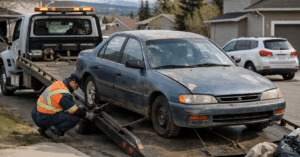
Call Calgary Scrap Auto Removal at 403-991-7717 and tell us it failed inspection and why. We buy out-of-province vehicles, insurance write-offs and non-repairable cars as they sit, pay cash up to $10,000, and send a flatbed anywhere in Calgary at no charge, so a vehicle that cannot legally be driven does not have to move under its own power. The yard at 4102 16a St SE, Calgary T2G 3T8 is open 9 am to 9 pm if you have questions about paperwork before you decide.